
0%
of the links it draws are correct
Real calls in the project1,025
- linked
- 100%
- possible
- 0%
- not drawn
- 0%
checked with tsc
Nodeway is a desktop app, free for now, that turns any repo into an interactive map of its files, functions, routes and database tables. Click a route to see every function and table it touches, with the code right beside it.
brew install nodewayhq/tap/nodewayFour moves cover most of what you need to understand a codebase you didn't write, or one you wrote a year ago.
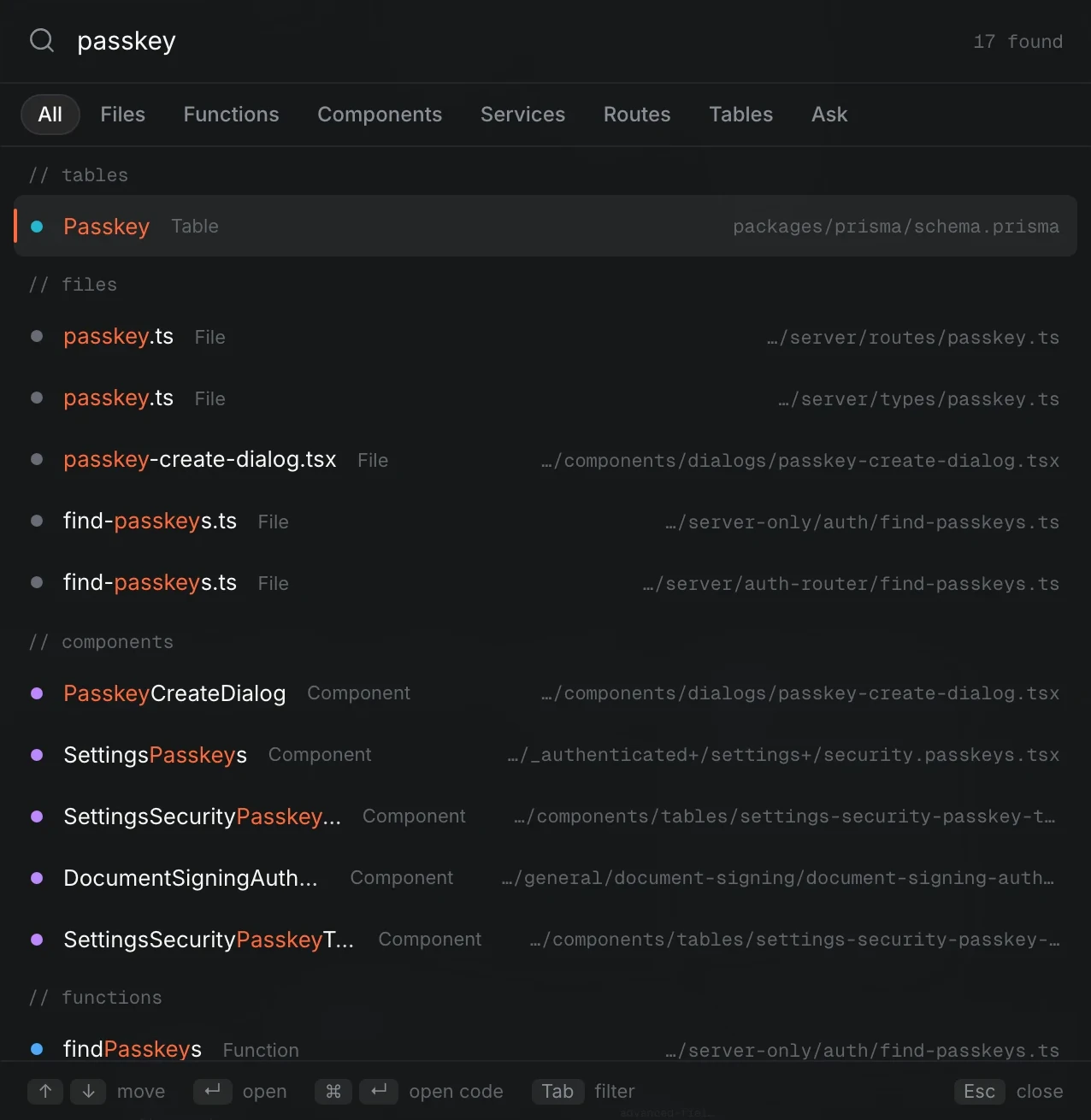
Search every file, function, component, route and table at once, ranked as you type. Or ask a question in plain English.
Every line on the map comes from a real import, call, route or query, not from file names or a model's guess.
Static analysis under the hood, a fast map on top, and the code one keystroke away.
TypeScript is resolved by the compiler, through imports, classes and dependency objects. Ten more languages are parsed with tree-sitter.
Tables, columns and foreign keys from Drizzle, Prisma, SQL, Django, SQLAlchemy, JPA, ActiveRecord and Eloquent.
Hono, Express, Next.js, FastAPI, Flask, Django, gin, chi, axum, Spring, ASP.NET, Rails and Laravel.
See what your branch changes against main and how many lines really need reading, with lockfiles and snapshots counted apart. When it's ready, open the pull request from here, with the description drafted for you.
Light up every function a branch or pull request changes, then everything that calls it: the routes, screens, tables and tests within a few hops. It opens instantly.
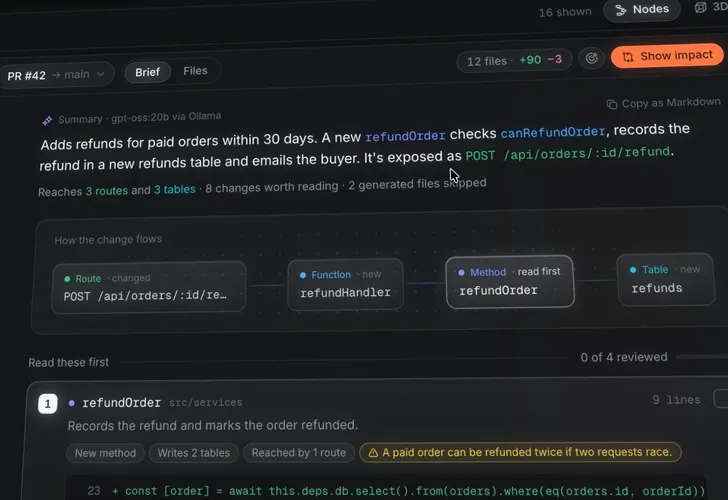
Open any pull request and get a brief: what to read first and why, how the change flows, and a short summary. Comment on lines, approve and merge without leaving the map.
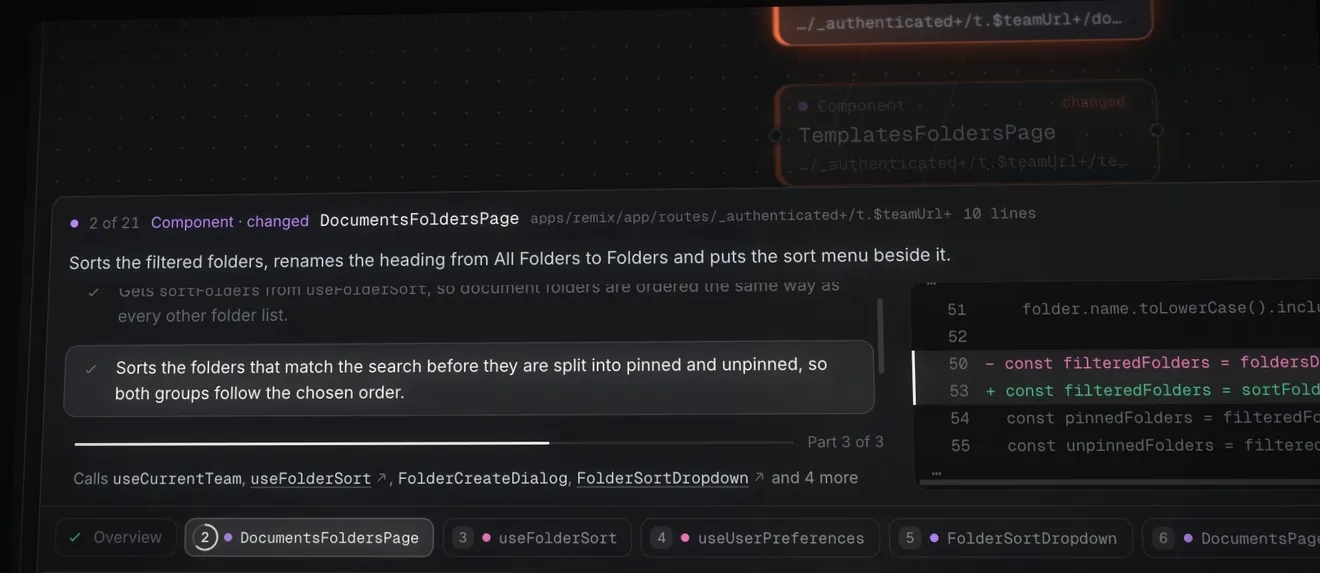
Press W on any pull request and Nodeway walks you through it one step at a time, in the order a request flows. The camera moves to each changed function, route, page or table, and each step explains the change part by part, beside the lines that changed.
Ask how something works in plain words. The answer is drawn from the map itself, so it links to the files, functions and tables involved and shows the path between them, one click from the code.
$ open -a "Nodeway" ~/code/shop
✓ 2,412 files read on this machine
✓ server on 127.0.0.1 only
· AI off until you add a key
Nothing leaves your computer to build the map. The server only listens on 127.0.0.1.
Search, trace, expand and read code without reaching for the mouse.
Nodeway is a desktop app. It reads your repository where it lives and keeps everything it learns about it on your computer.
Analysed on your computer
Your code is read and mapped locally. Nothing is uploaded to build the map.
Private by default
The Nodeway server only listens on 127.0.0.1, so nothing else on your network can reach it.
AI only if you want it
Explanations and Ask use your own key for Anthropic, OpenAI, Gemini, OpenRouter or Ollama, or Ollama running on your own machine. Leave it out and Nodeway works fully offline.
Eleven languages are read down to functions, imports, calls, routes and tables. Mixed repos land on one map, so a Go API and a TypeScript frontend sit side by side.
We ran Nodeway on real open-source projects and compared every call it linked with what the language's own tooling says is true. These are the results.
0%
of the links it draws are correct
Real calls in the project1,025
checked with tsc
0%
of the links it draws are correct
Real calls in the project303
checked with Pyright
0%
of the links it draws are correct
Real calls in the project522
checked with go/types
0%
of the links it draws are correct
Real calls in the project2,281
checked with rust-analyzer
0%
of the links it draws are correct
Real calls in the project91
checked with javac
0%
of the links it draws are correct
Real calls in the project232
checked with Roslyn
0%
of the links it draws are correct
Real calls in the project2,234
checked with Clang
0%
of the links it draws are correct
Real calls in the project350
checked with Clang
Measured 13 Nov 2026 on one project per language, with test files left out. Calls into libraries that are not downloaded are left out of the score.
We timed a full map of five popular open-source projects, from listing the files to the last route and table.
103 routes · 55 tables · 7,115 links
344 routes · 101 tables · 14k links
20 routes · 198 tables · 95k links
580 routes · 68 tables · 263k links
194 routes · 87 tables · 148k links
Measured 15 Nov 2026 on a MacBook Pro (M1 Pro, 16 GB): the average of 2 cold runs per repo at its latest commit, with test files left out. Links are the imports and calls Nodeway drew.
No. Nodeway reads and maps your repository on your computer, and its server only listens on 127.0.0.1. If you turn on AI features, only what's needed to answer goes to the provider you chose, using your own key. Usage sharing is off unless you turn it on, and then it only counts which features get used.
Open a folder and Nodeway maps it. Every map is cached per commit, so reopening is instant.
Or on a Mac, with Homebrew:
brew install nodewayhq/tap/nodeway